The early universe may have been far more ambitious than scientists ever imagined. Astronomers have identified a massive galaxy cluster already taking shape just one billion years after the Big Bang, a time when the cosmos was thought to be far too young and chaotic to build structures of this scale.
Using a powerful combination of observations from the James Webb Space Telescope and the Chandra X-ray Observatory, researchers have uncovered evidence that challenges long-standing models of how quickly the universe evolved after its fiery birth.
What Is This Discovery About?
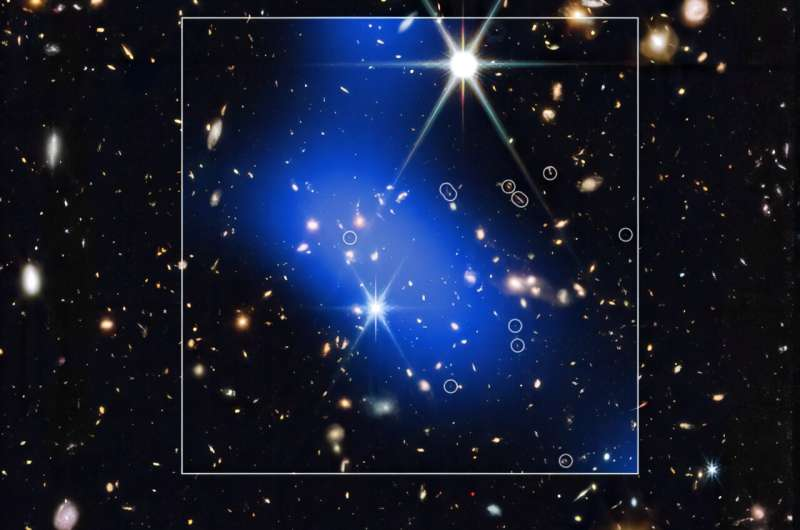
The newly observed structure is what astronomers call a protocluster, an early-stage galaxy cluster in the process of forming. This particular protocluster contains at least 66 candidate galaxies and has a total mass equivalent to around 20 trillion Suns.
What makes the discovery remarkable is its age. The protocluster dates to a time when the universe was only about 7% of its current age. Until now, the earliest known galaxy clusters of comparable scale formed roughly three billion years after the Big Bang, making this find dramatically earlier than expected.
Galaxy clusters are the largest gravitationally bound structures in the universe. They consist of hundreds or even thousands of galaxies, immersed in vast halos of superheated gas and held together by enormous quantities of dark matter. Seeing one emerge so early suggests the universe was assembling complex structures at breakneck speed.
News Source: Live Science, Phys Org
How Webb and Chandra Uncovered the Protocluster
The discovery was made possible by combining two very different views of the cosmos. The James Webb Space Telescope identified the galaxies themselves using infrared light, allowing astronomers to peer deep into the early universe where visible light cannot easily travel.
Meanwhile, the Chandra X-ray Observatory detected X-ray emissions from superheated gas within the protocluster. This hot gas is a defining feature of mature galaxy clusters and is heated to millions of degrees as it falls into the cluster’s gravitational well.
Together, these observations revealed something unexpected. The protocluster already shows the hallmarks of a mature system, including a centrally concentrated X-ray glow and a surrounding halo of hot gas. Under current cosmological models, such features should not yet exist at this early stage of cosmic history.
Why This Challenges Our Understanding of the Universe
Modern cosmology predicts that large structures like galaxy clusters take billions of years to assemble. Early in the universe, matter was thought to be too evenly distributed, with galaxies still forming and spreading apart, to allow such massive systems to emerge.
This discovery directly contradicts that assumption. According to the researchers, the universe appears to have grown structures much faster than predicted, implying that existing models may be missing key physics.
Dark matter plays a crucial role here. Although it does not emit or reflect light, dark matter makes up about 85% of all matter in the universe. Its gravitational influence governs how galaxies and clusters form. Finding such an advanced protocluster so early suggests that dark matter may have clumped and collapsed more efficiently than models currently allow.
Part of a Bigger Pattern in the Early Universe
This discovery does not stand alone. Over the past few years, Webb has repeatedly revealed surprises from the early universe, including:
- Galaxies that are far brighter and more massive than expected
- Supermassive black holes already in place just 500 million years after the Big Bang
- Rapid star formation occurring much earlier than models predicted
Together, these findings paint a picture of a universe that wasted no time getting started. Instead of a slow, gradual build-up, the cosmos may have experienced a period of rapid, accelerated growth, forming galaxies, black holes, and now clusters far earlier than anyone anticipated.
A Universe with Unfinished Explanations
The discovery of this ancient protocluster strengthens the growing sense that our understanding of the universe’s earliest chapters is incomplete. While existing models have successfully explained much of cosmic evolution, they may underestimate how quickly matter organised itself after the Big Bang.
As astronomers continue combining data from Webb, Chandra, and future observatories, more early-universe surprises are almost guaranteed. Each new find brings scientists closer to rewriting the story of how the cosmos grew up — and how fast it really did.
For now, one thing is clear: the universe did not take its time. It sprinted.