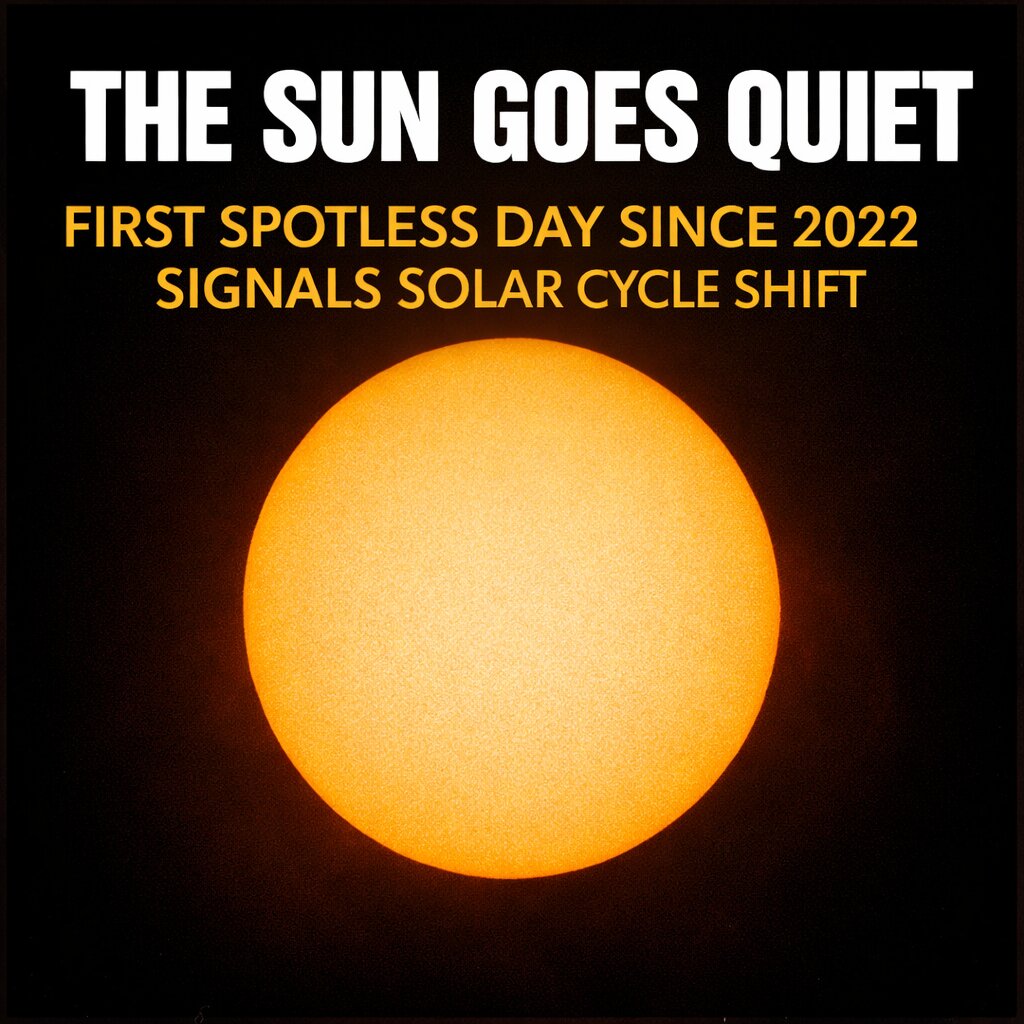

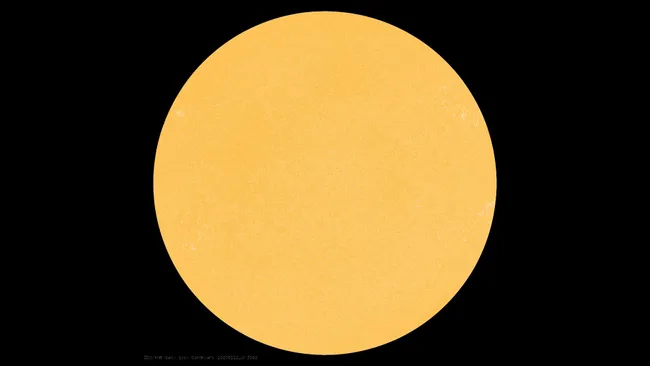
For the first time in more than three years, the face of the Sun has appeared completely spotless.
On February 22, 2026, images from NASA’s Solar Dynamics Observatory showed a smooth, unblemished solar disk — something not seen since June 2022. After 1,355 days of visible sunspot activity, the Sun briefly entered a rare calm phase.
But does this mean the current solar cycle is ending? Or is this simply a temporary breath between storms?
What Does a Spotless Sun Actually Mean?
Sunspots are darker, cooler regions on the Sun’s surface created by intense magnetic activity. When these magnetic fields twist and snap, they unleash solar flares and coronal mass ejections — the explosive events responsible for geomagnetic storms and auroras on Earth.
The Sun operates on an approximately 11-year solar cycle. During solar maximum, sunspots are frequent and solar storms are common. During solar minimum, activity declines dramatically and spotless days can stretch into months.
The current cycle, Solar Cycle 25, peaked in 2024. Since then, astronomers have been watching for signs that the Sun’s activity is beginning its long descent toward minimum.
A spotless day is one such sign — but it is not a final curtain call.
Is Solar Cycle 25 Already Ending?
Not quite.
While the recent spotless observation suggests activity is slowing, experts do not expect the next solar minimum to occur until around 2030. Solar cycles taper gradually, and brief quiet periods can occur even during active phases.
In fact, just two days after the spotless observation, a new active region began rotating into view. It is also possible that other sunspots were present on the far side of the Sun, temporarily hidden from Earth-facing instruments.
Solar behaviour is rarely linear. Instead, it fluctuates in waves, sometimes surprising even seasoned solar physicists.
What This Means for Auroras in 2026
For skywatchers hoping for dramatic northern and southern lights displays, this spotless day does not mean the auroras are disappearing.
Even during the declining phase of a solar cycle, powerful eruptions can still occur. The Sun does not switch off overnight. Instead, activity gradually becomes less frequent and less intense.
If anything, we are likely entering a transitional period — fewer major geomagnetic storms than in 2024, but still enough solar outbursts to keep aurora chasers alert.
A Brief Lull Before the Next Wave
The spotless Sun of February 22, 2026 may mark the beginning of Solar Cycle 25’s slow decline — or it may simply be a short pause in an otherwise active star.
Our Sun is dynamic, magnetic, and unpredictable. One quiet day does not end a cycle. But it does remind us that even stars breathe.
And for a moment, the most powerful object in our solar system went silent.