Scientists believe that a mysterious state of matter that existed just moments after the Big Bang could still exist today, hidden deep inside neutron stars. New research suggests that upcoming gravitational wave detectors may finally allow astronomers to confirm whether this exotic material is present inside these ultra-dense stellar remnants.
Neutron stars are among the most extreme objects in the universe. They form when massive stars explode in supernova events and collapse into incredibly compact objects. Despite being roughly the size of a city, a neutron star can contain more mass than our Sun, creating immense gravitational pressure in its interior.
Because of this pressure, matter inside a neutron star behaves in ways that are impossible to reproduce under normal conditions. Scientists believe the intense compression may break apart ordinary particles and create an exotic form of matter known as quark-gluon plasma, a state thought to have filled the universe shortly after the Big Bang.
Now researchers think gravitational waves could provide the key to detecting this mysterious state of matter.
The strange interior of neutron stars
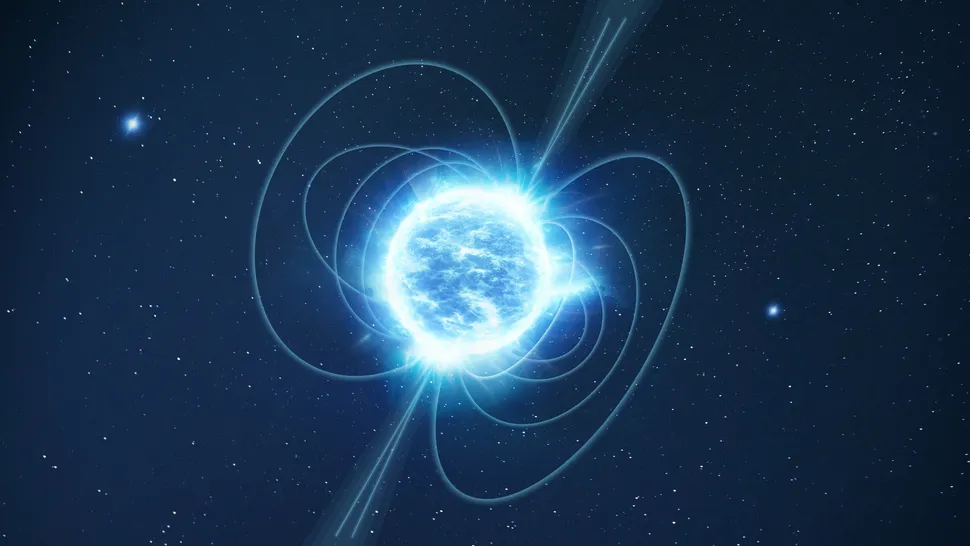
A neutron star forms when the core of a massive star collapses after a supernova explosion. During this collapse, gravity compresses matter to such extreme levels that atoms can no longer survive in their normal form.
Under these crushing conditions, electrons and protons are forced together to form neutrons. This creates a dense core of neutron-rich matter that gives neutron stars their name.
However, conditions deep inside a neutron star may be even more extreme. Scientists believe that the pressure near the core may break apart neutrons themselves, releasing the smaller particles that make them up.
These particles are called quarks, and they are normally bound together by particles known as gluons. When quarks and gluons exist freely in a dense, hot environment, they form a state of matter known as quark-gluon plasma.
This exotic plasma filled the universe during the first fractions of a second after the Big Bang. Outside of particle accelerator experiments on Earth, neutron stars may be the only place in the universe where this primordial matter still exists.
Gravitational waves reveal the hidden interior
The challenge for astronomers is figuring out how to observe something hidden deep inside a neutron star. Direct observation is impossible because the star’s surface blocks any view of its interior.
Instead, scientists are turning to gravitational waves.
Gravitational waves are ripples in spacetime created by massive objects moving through space. They were first detected in 2015 when the LIGO observatory observed waves produced by merging black holes.
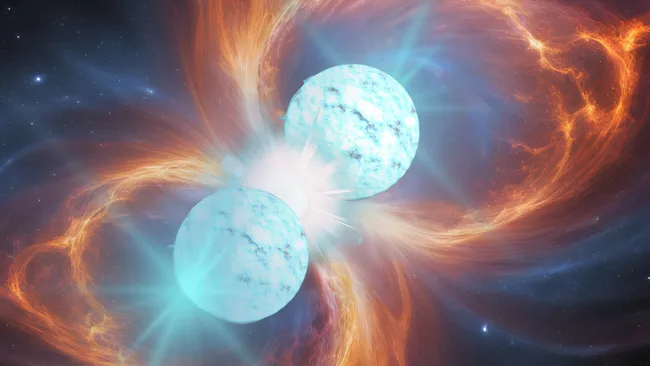
When two neutron stars orbit each other in a binary system, they gradually spiral together before colliding in a powerful event called a kilonova. During this inspiral phase, the stars emit gravitational waves that can travel across the universe.
As the neutron stars approach each other, their intense gravity distorts their shapes through tidal forces. These distortions cause vibrations inside the stars, similar to the way a bell rings when struck.
The frequencies of these internal vibrations become encoded within the gravitational waves emitted by the system. By analysing those frequencies, scientists may be able to determine what the stars are made of.
Decoding the physics of extreme matter
A research team led by Nicolás Yunes of the University of Illinois and Abhishek Hegade of Princeton University believes they have developed a theoretical framework that could reveal this hidden information.
Their work focuses on identifying the oscillation patterns that occur inside neutron stars as they interact gravitationally with a companion star. These oscillations produce specific signatures within gravitational waves.
If scientists can measure those signatures accurately, they may be able to determine whether neutron stars contain exotic matter such as quark-gluon plasma.
The calculations involved are extremely complex because neutron stars exist in environments governed by Einstein’s theory of general relativity rather than classical Newtonian physics.
To solve the problem, the researchers divided the interior of a neutron star into regions where gravity behaves differently. By analysing each region separately and then combining the results, they were able to identify a full set of oscillation modes for the star.
These modes describe how the star vibrates internally and how those vibrations affect the gravitational waves emitted during a neutron star merger.
The next generation of detectors
At present, gravitational wave detectors such as LIGO and Virgo are not sensitive enough to capture the higher frequency signals needed to study these internal oscillations.
However, future detectors currently being planned could provide the necessary precision.
Next-generation gravitational wave observatories will be able to detect far more detailed signals from neutron star mergers. This improved sensitivity could allow scientists to measure the subtle tidal effects and oscillation patterns predicted by the new research.
If those measurements confirm the presence of quark-gluon plasma inside neutron stars, it would provide an extraordinary glimpse into the physics of the early universe.
Understanding neutron star interiors could reveal how matter behaved in the first moments after the Big Bang, when the universe was far hotter and denser than it is today.
For astronomers and physicists, neutron stars may become natural laboratories for studying some of the most extreme conditions in the cosmos.
And with the next generation of gravitational wave detectors on the horizon, scientists may soon be able to listen to the hidden vibrations of these cosmic objects and uncover what lies at their mysterious cores.