The Hubble Space Telescope is celebrating its 36th anniversary in orbit with a breathtaking new image of the Trifid Nebula, one of the most iconic star-forming regions in the night sky.
Launched on 24 April 1990, Hubble has spent decades revealing the hidden beauty of the universe. This latest image is more than just a celebration. It is a reminder that even after more than three decades, the telescope continues to deliver groundbreaking science and awe-inspiring visuals.
The new view zooms deep into the nebula, capturing intricate structures of gas and dust that are invisible to the naked eye.
A closer look at a stellar nursery
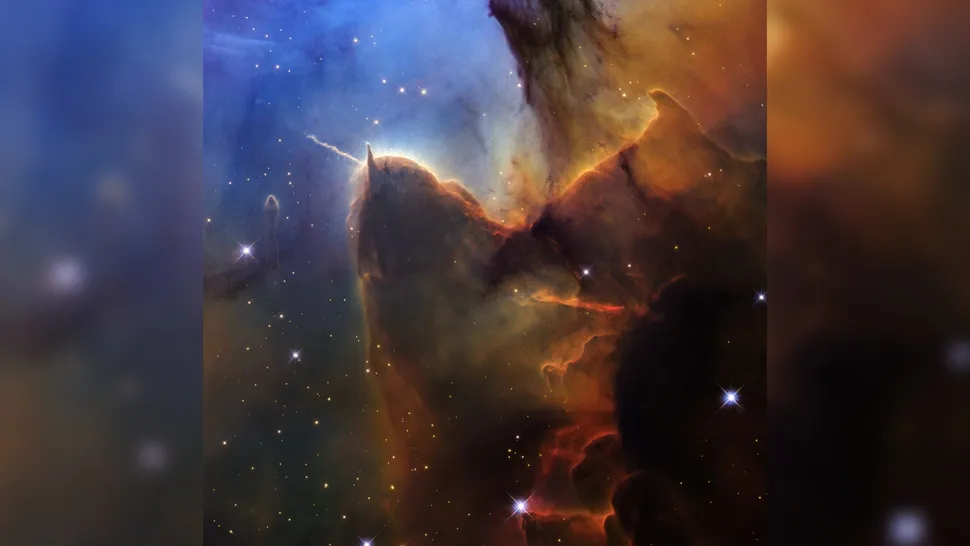
The Trifid Nebula, located over 4,000 light-years away in the constellation of Sagittarius, is a region where new stars are actively forming.
Hubble’s latest image focuses on a small section of the nebula, revealing towering pillars of gas and sweeping clouds shaped by intense radiation from nearby young stars.
One of the most striking features is a dense column of gas that has resisted erosion from powerful stellar winds. At its tip lies a forming star, still wrapped in its natal material. Around it, astronomers can detect what appears to be a circumstellar disk, the early building blocks of a future planetary system.
This is the kind of detail that ground-based telescopes simply cannot achieve.
Jets, pillars, and cosmic chaos
Not everything in this region forms in a calm and orderly way. Hubble also captured a dramatic jet of material known as a Herbig–Haro object, specifically HH 399.
This jet is produced by a young protostar ejecting excess material at high speeds along its axis of rotation. It cuts through the surrounding nebula, stretching light-years into space.
By comparing this new image with earlier observations from 1997, astronomers can track how this jet has changed over nearly three decades. This provides valuable insight into how young stars interact with their environment.
It is essentially a time-lapse of stellar evolution on a cosmic scale.
Light, darkness, and hidden stars
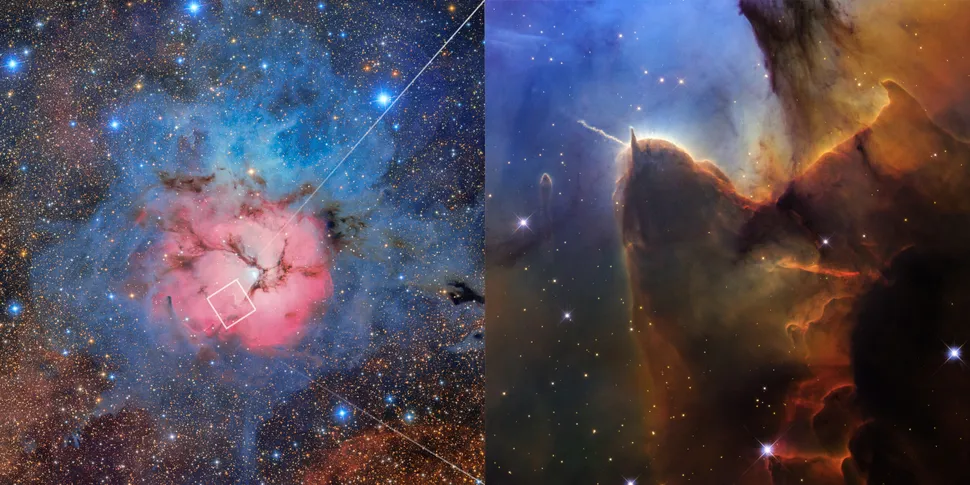
One of the most fascinating aspects of the image is the contrast between bright and dark regions.
The dark areas might appear empty at first glance, but they are anything but. These regions are filled with dense clouds of dust that block visible light, hiding potential star formation within.
In contrast, the glowing blue regions are where ultraviolet radiation is actively clearing away gas and dust. This process reveals the structure of the nebula while simultaneously shaping it.
It is a powerful reminder that what we see in space is often just the surface of much deeper processes.
What 36 years of Hubble has achieved
Since its launch, the Hubble Space Telescope has made more than 1.7 million observations, contributing to around 23,000 scientific papers.
Its discoveries have transformed our understanding of the universe, from measuring the expansion rate of space to capturing detailed images of distant galaxies and nebulae.
Even today, Hubble continues to play a vital role alongside newer observatories. It remains one of the most productive scientific instruments ever created.
Still exploring, still inspiring
The latest image of the Trifid Nebula is more than just a celebration of the past. It is proof that the Hubble Space Telescope is still pushing the boundaries of what we can see and understand.
As technology advances and new missions take to the skies, Hubble continues to hold its place as a cornerstone of modern astronomy. Its ability to reveal the beauty and complexity of the universe remains unmatched in many ways.
After 36 years, one thing is clear. Hubble is not done yet.