
Exoplanets are one of the most exciting discoveries in modern astronomy. Simply put, exoplanets are planets that exist outside our solar system, orbiting stars other than our Sun. Over the past few decades, astronomers have confirmed thousands of these distant worlds, transforming our understanding of the universe.
For readers of Casual Astronomer, this guide will break down what exoplanets are, how scientists classify them, and highlight some of the most fascinating discoveries so far.
What exactly are exoplanets
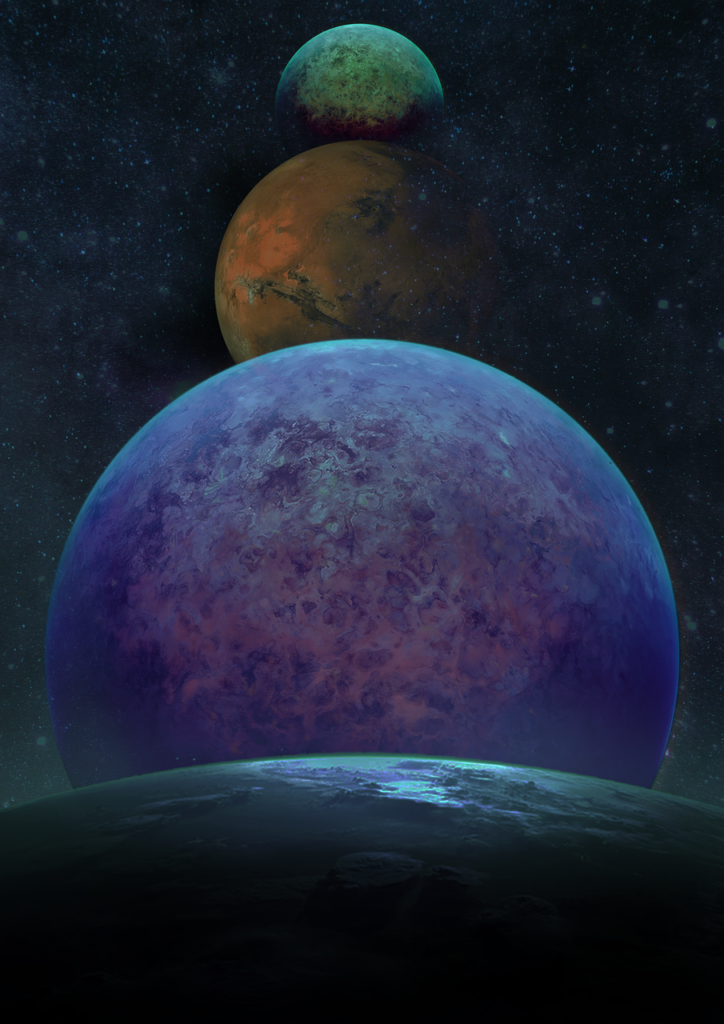
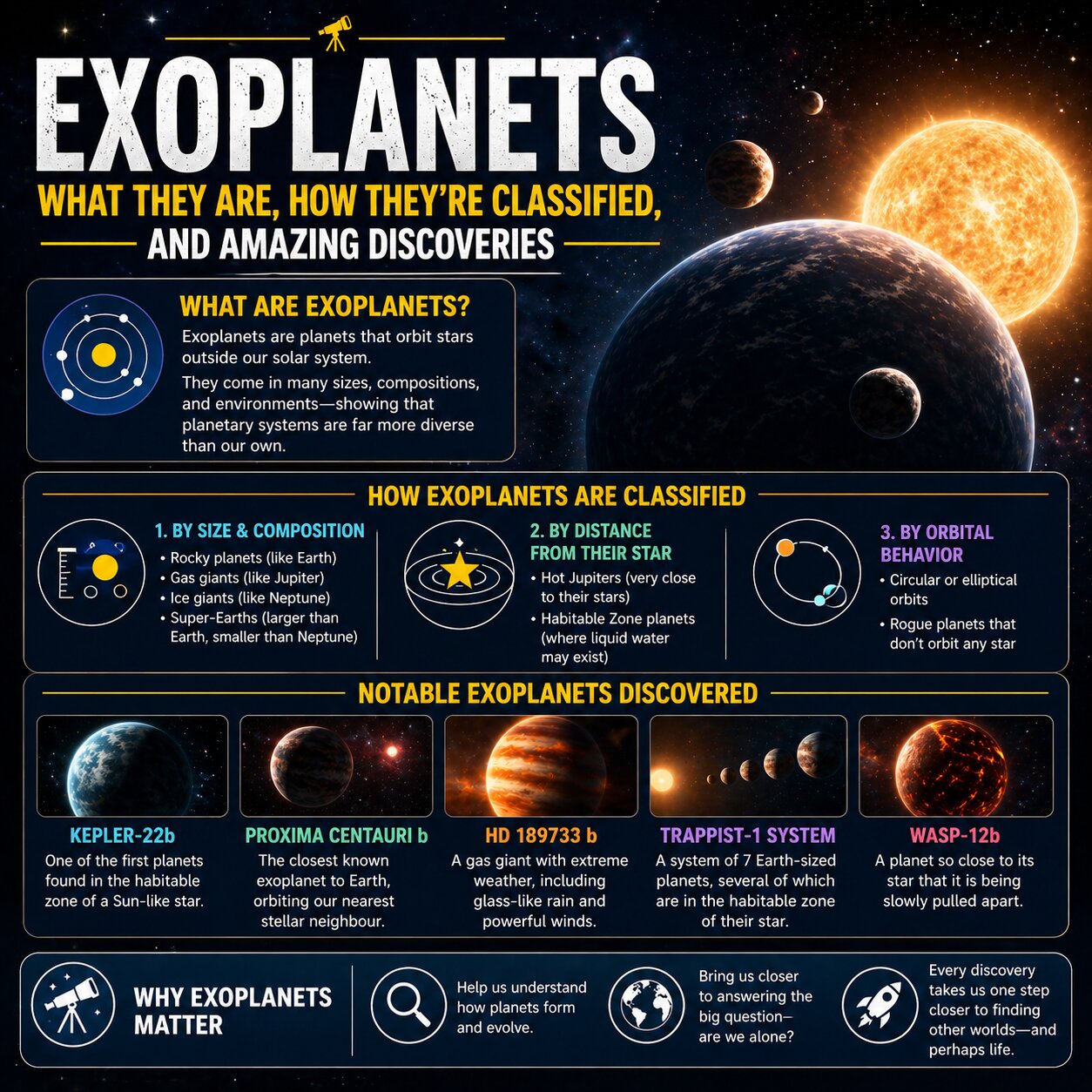
Exoplanets, also known as extrasolar planets, are planets that orbit stars beyond our solar system. Unlike the eight planets we are familiar with, these worlds can vary dramatically in size, composition, and environment.
Some exoplanets are massive gas giants larger than Jupiter, while others are rocky worlds similar to Earth. Many exist in extreme conditions, such as orbiting very close to their stars or drifting in freezing outer regions. The diversity of exoplanets shows that planetary systems can form in ways very different from our own.
Astronomers detect exoplanets using methods such as the transit method, where a planet passes in front of its star, and the radial velocity method, where a star wobbles slightly due to a planet’s gravitational pull.
How exoplanets are classified
Exoplanets are classified based on their size, composition, and distance from their host star. This helps scientists better understand how they form and whether they might support life.
Size and composition
Planets are often grouped into categories such as rocky planets, gas giants, and ice giants. Rocky exoplanets are similar to Earth and Mars, while gas giants resemble Jupiter and Saturn. Ice giants, like Uranus and Neptune, contain heavier volatile elements.
Another important category is super-Earths. These are planets larger than Earth but smaller than Neptune, and they are among the most commonly discovered types of extrasolar planets.
Distance from their star
Distance plays a key role in classification. Some extrasolar planets orbit extremely close to their stars and are known as hot Jupiters. These planets experience extreme temperatures and harsh radiation.
Others fall within what scientists call the habitable zone. This is the region around a star where conditions may allow liquid water to exist on a planet’s surface. These planets are of particular interest in the search for life beyond Earth.
Orbital behaviour
Extrasolar planets can also be classified by their orbits. Some have circular paths similar to Earth, while others follow highly elliptical orbits. There are even rogue planets that do not orbit any star at all, drifting freely through space.
Notable exoplanets discovered so far
- Kepler-22b – One of the first planets found in the habitable zone of a Sun-like star
- Proxima Centauri b – The closest known exoplanet to Earth, orbiting our nearest stellar neighbour
- HD 189733 b – A gas giant with extreme weather, including glass-like rain driven by high winds
- TRAPPIST-1 system – A group of seven Earth-sized planets, several within the habitable zone
- WASP-12b – A planet so close to its star that it is being slowly pulled apart
These discoveries highlight just how diverse and extreme exoplanets can be, from potentially habitable worlds to planets that defy imagination.
Why exoplanets matter
Studying exoplanets helps scientists answer some of the biggest questions in astronomy. How common are planetary systems? Are there other Earth-like worlds? Could life exist elsewhere in the universe?
Each new discovery brings us closer to understanding our place in the cosmos. Exoplanets also help researchers refine theories about how planets form and evolve over time.
As technology improves, astronomers are beginning to analyse the atmospheres of distant planets, searching for signs of water, oxygen, and other indicators of life.
Looking beyond our solar system
Exoplanets remind us that our solar system is just one of many. The universe is filled with countless stars, each potentially hosting its own collection of worlds.
For beginners and enthusiasts alike, learning about extrasolar planets opens the door to a much larger perspective of space. It is not just about distant stars, but about the possibility of entirely new worlds waiting to be explored.
As we continue to discover more extrasolar planets, one thing becomes clear. The universe is far more diverse, mysterious, and fascinating than we ever imagined.