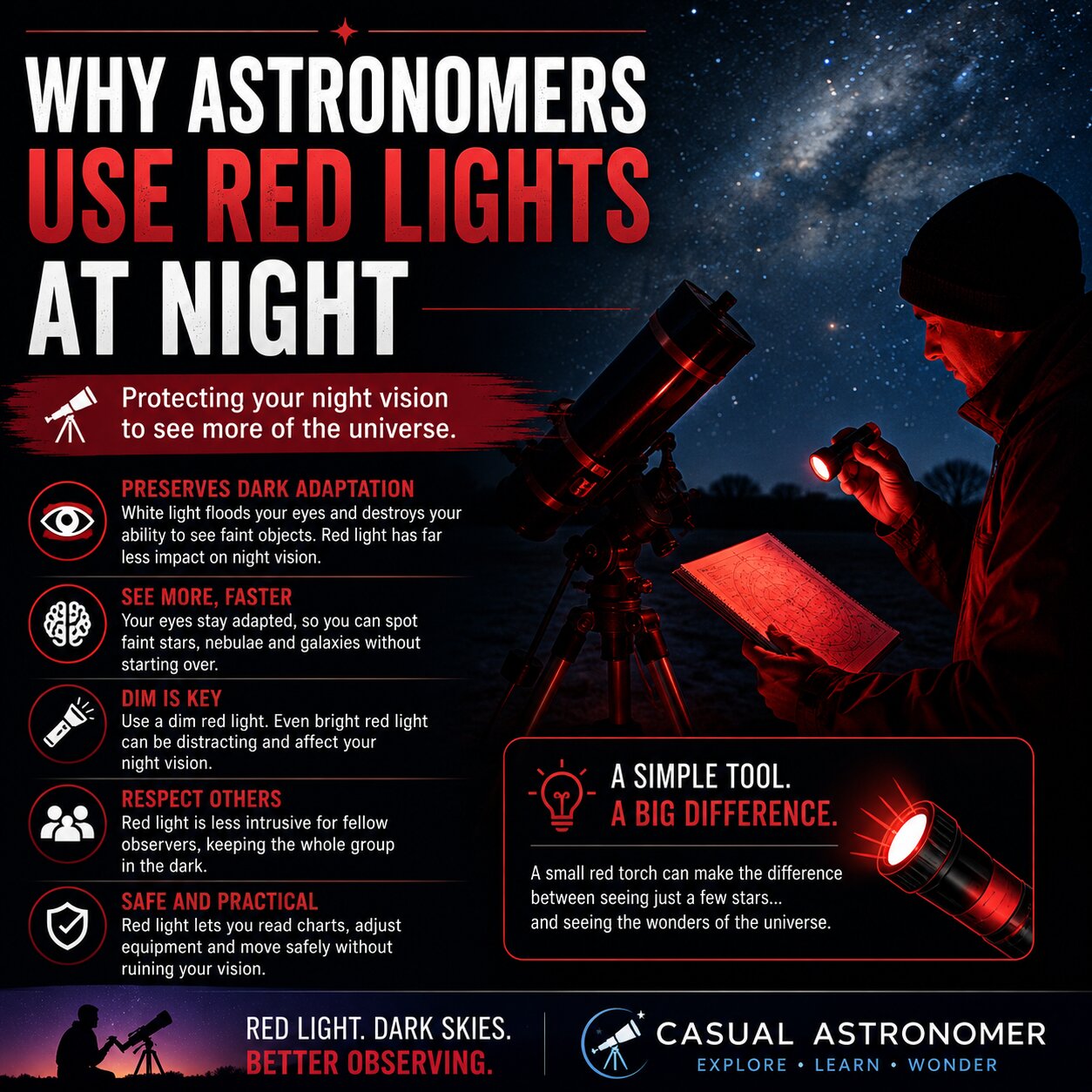

Attend an astronomy observation session after dark and you may notice people using dim red torches instead of ordinary white ones. It isn’t simply an astronomy tradition.
It helps observers preserve their night vision.
Protecting Dark Adaptation
When you move from a brightly illuminated environment into darkness, your eyes need time to adjust. As dark adaptation develops, you become increasingly capable of seeing faint objects and details in the night sky.
A sudden burst of bright white light can interfere with that adaptation, leaving you waiting for your eyes to adjust again.
Dim red illumination is commonly used by amateur astronomers because it is generally less disruptive to dark-adapted vision than bright white light. It can provide enough illumination to check equipment, read notes or safely find something nearby without flooding the observing area with brightness.
The key word, however, is dim. An extremely bright red light can still become distracting to observers.
This is why astronomy torches often have adjustable brightness settings.
It is a remarkably simple piece of equipment, but a red torch can make an observing session much more comfortable — especially when several astronomers are sharing the darkness and nobody wants their carefully developed night vision unexpectedly destroyed.