
A new scientific breakthrough is changing how we understand alien oceans. Researchers have discovered that on Saturn’s largest moon, Titan, even the lightest breeze could generate massive waves, far larger than anything we would expect under similar conditions on Earth.
This fascinating insight comes from a new model developed by scientists at MIT, offering a fresh perspective on how liquids behave across different worlds. For space enthusiasts and future exploration missions, this could be a game-changer.
Titan’s lakes are more dynamic than we thought
Titan is already one of the most intriguing bodies in our solar system. It is the only place besides Earth known to have stable liquid lakes on its surface. However, unlike Earth, these lakes are made of liquid methane and ethane rather than water.
According to the new study, these hydrocarbon lakes behave very differently from Earth’s oceans. A gentle wind that would barely ripple a lake on Earth could produce waves as high as 10 feet on Titan .
This surprising behaviour comes down to Titan’s unique conditions. Its lower gravity, combined with lighter liquid composition and atmospheric differences, allows waves to grow much larger with less energy.
A new model called “PlanetWaves”
The research team developed a new simulation tool called “PlanetWaves,” designed to predict how waves form under different planetary conditions. Unlike earlier models, this one considers multiple factors at once, including gravity, atmospheric pressure, and the physical properties of liquids.
This comprehensive approach allows scientists to better understand not just Titan, but also ancient Mars and even distant exoplanets. It marks a significant step forward in planetary science and modelling.
The model was first tested using real data from Earth, specifically wave measurements from Lake Superior. It successfully predicted wave behaviour under Earth conditions, giving researchers confidence in applying it to other worlds.
What would Titan’s waves look like?
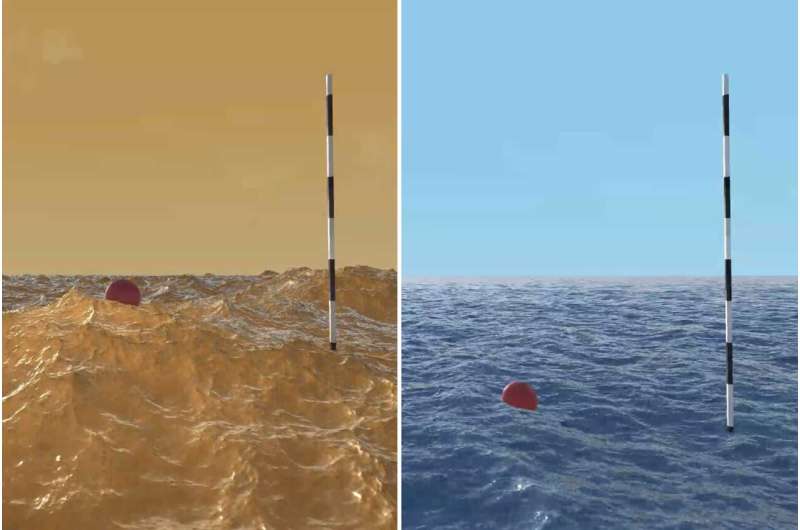
Imagine standing on the shore of a lake under a calm sky. On Earth, you would see small ripples forming across the surface. On Titan, however, that same gentle breeze would send slow-moving, towering waves rolling toward you.
Scientists describe these waves as almost surreal—large and powerful, yet moving in slow motion due to Titan’s environment .
This creates a strange and beautiful image of an alien shoreline, where familiar physics behave in unfamiliar ways.
Why this matters for space exploration
Understanding wave behaviour on Titan is not just theoretical. It has real implications for future missions. If humanity ever sends probes or floating instruments to Titan’s lakes, engineers will need to design them to withstand these unexpectedly large waves.
Knowing what conditions to expect could make the difference between mission success and failure. The research provides valuable data for planning future exploration of one of the solar system’s most promising destinations.
It also helps scientists answer bigger questions about how landscapes form on other worlds, including why Titan’s coastlines look so different from Earth’s.
Rethinking oceans across the universe
The implications of this study go far beyond Titan. The same model suggests that on some planets, even extreme winds might barely disturb the surface of dense liquids, such as lava oceans on distant worlds.
This highlights how diverse planetary environments can be. What seems normal on Earth may be completely different elsewhere, reminding us that our understanding of physics is often shaped by our own planet’s conditions.
A new wave of discovery
This discovery opens the door to a deeper understanding of alien worlds and their environments. Titan continues to stand out as one of the most Earth-like yet mysterious places in our solar system, and studies like this bring us one step closer to unlocking its secrets.
As scientists refine their models and future missions take shape, we may soon witness these towering alien waves not just in theory, but through real images from the surface of Titan.