NASA’s Hubble Space Telescope has captured striking new observations of vast clouds of cosmic dust, created by what scientists believe were massive collisions between large bodies in a distant star system. These dramatic events offer astronomers a rare opportunity to study how planetary systems evolve through violent impacts.
The observations focus on the region surrounding Fomalhaut, a well-known star located about 25 light-years from Earth. Fomalhaut has long fascinated astronomers due to its extensive debris disk, often compared to a younger version of our own Solar System.
Evidence of colossal cosmic impacts
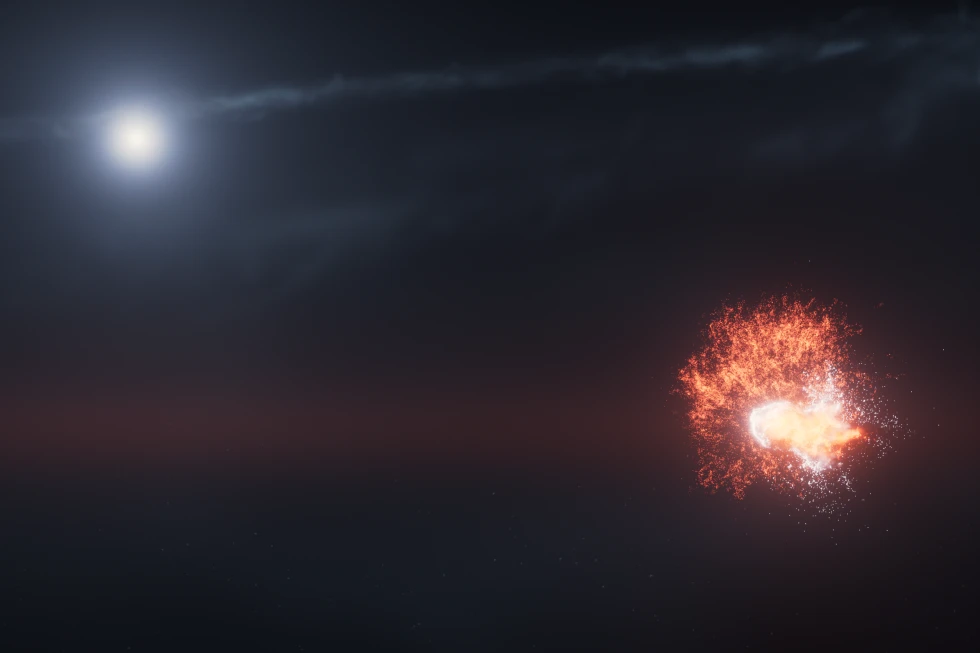
The dust clouds detected by Hubble are far larger than anything produced by typical asteroid collisions. Scientists believe these clouds were formed when objects hundreds of kilometres across smashed into each other at extreme speeds.
Unlike short-lived debris plumes, these dust clouds persist for years, slowly expanding as radiation pressure from the star pushes the fine particles outward. Their size and longevity strongly suggest planet-scale collisions, events that play a crucial role in shaping planets and debris disks.
Why these collisions matter
Massive impacts are not just destructive; they are fundamental to planetary formation. In the early Solar System, similar collisions are thought to have:
- Shaped the terrestrial planets
- Contributed to the formation of moons
- Cleared unstable debris from planetary orbits
By observing collisions in other systems, astronomers gain insight into how common these violent processes are and how long planetary systems remain dynamically active.
The Fomalhaut system, once thought to be relatively settled, now appears far more chaotic than expected.
A window into planetary system evolution
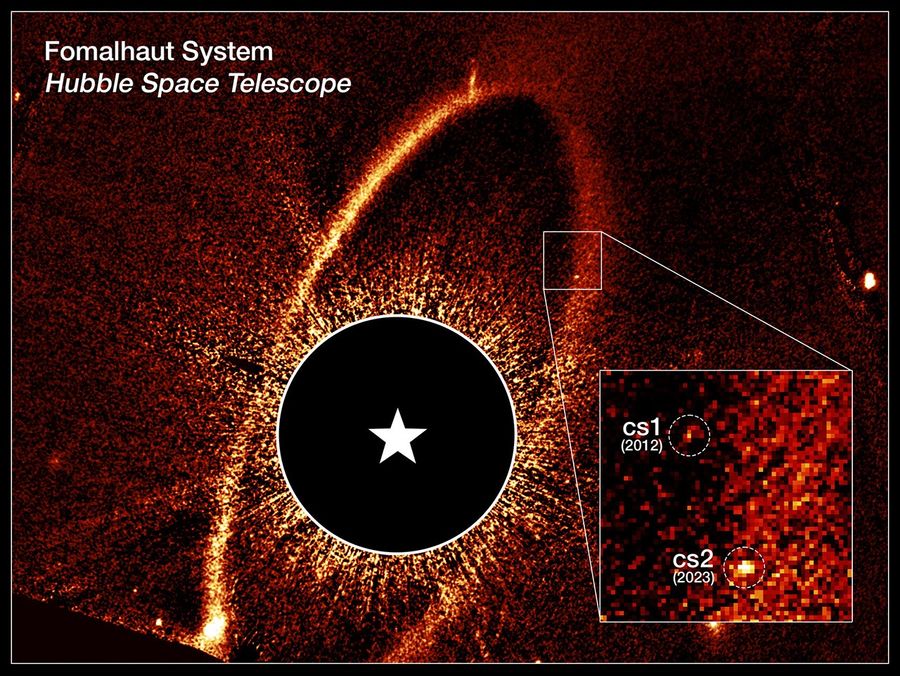
One of the most valuable aspects of this discovery is timing. Astronomers rarely catch collision events in progress, making these observations especially important. The dust clouds act as fossil records of recent impacts, allowing scientists to estimate collision energy, object size, and orbital behaviour.
Hubble’s long-term monitoring capabilities make it uniquely suited to track how these dust structures change over time, providing clues about unseen planets whose gravity may be stirring up the debris.
News Source: NASA
What this means for our understanding of space
The discovery reinforces the idea that planetary systems remain active and unstable for far longer than previously assumed. Even mature stars like Fomalhaut can host dramatic collisions that reshape their surroundings.
As future observatories, including the James Webb Space Telescope, continue studying these systems in greater detail, astronomers expect to uncover even more evidence that chaos and creation go hand in hand across the universe.
For casual stargazers and astronomy enthusiasts alike, these findings are a powerful reminder that space is not static. It is a constantly evolving arena where worlds are shaped by both beauty and destruction.