Planet Jupiter is the largest planet in our Solar System and one of the most fascinating worlds ever studied. Its immense size, powerful gravity, swirling storms, and complex system of moons make it a dominant force that shapes the architecture of the planets around it.
From its iconic Great Red Spot to its hidden core and radiation belts, Planet Jupiter offers scientists a window into how gas giants form, evolve, and influence entire planetary systems. Studying Jupiter helps us understand not only our own Solar System, but gas giants orbiting distant stars.
Quick Stats: Planet Jupiter
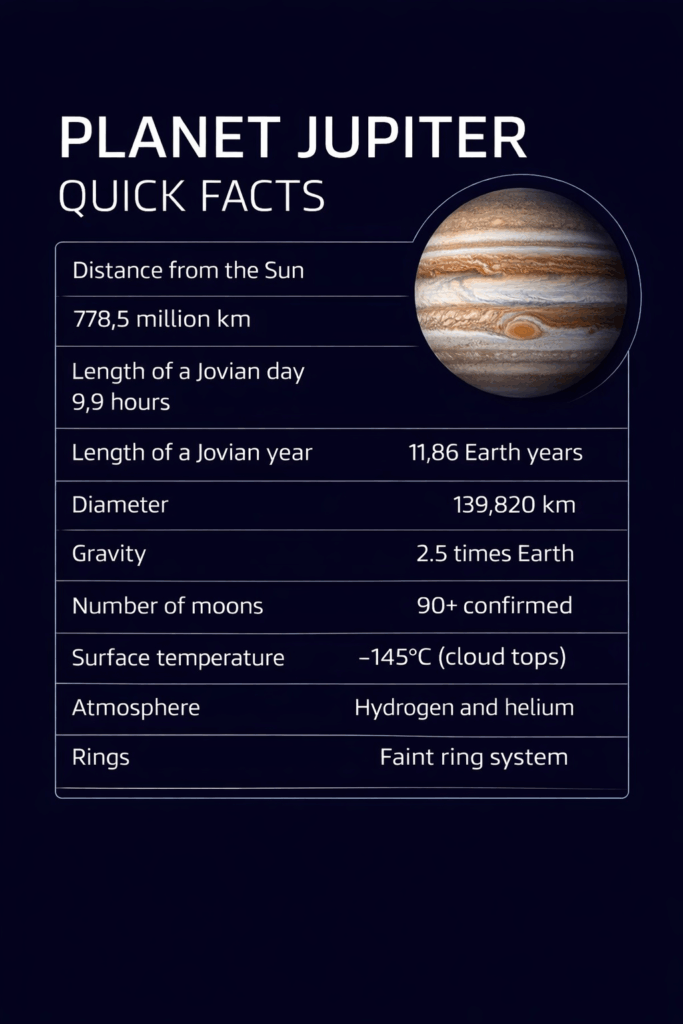
| Feature | Details |
|---|---|
| Distance from the Sun | 778.5 million km |
| Length of a Jovian day | 9.9 hours |
| Length of a Jovian year | 11.86 Earth years |
| Diameter | 139,820 km |
| Gravity | 2.5 times Earth |
| Number of moons | 90+ confirmed |
| Surface temperature | -145°C (cloud tops) |
| Atmosphere | Hydrogen and helium |
| Rings | Faint ring system |
Jupiter’s Position in the Solar System
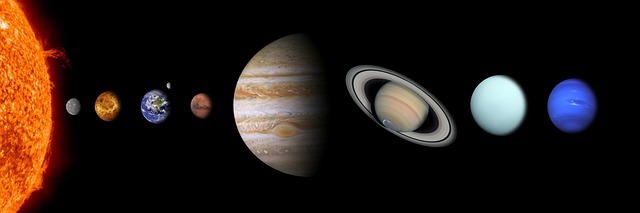
Planet Jupiter is the fifth planet from the Sun and sits beyond the inner rocky planets and the asteroid belt. Its enormous gravity plays a crucial role in shaping the Solar System by influencing asteroid paths and capturing or deflecting objects that might otherwise reach the inner planets.
Because of its size, Planet Jupiter contains more mass than all the other planets combined. This mass affects orbital stability across the Solar System and may have helped Earth avoid catastrophic impacts during its early history. Many astronomers consider Jupiter a cosmic shield, though its gravitational pull can also redirect objects inward under certain conditions.
A World of Storms and Cloud Bands
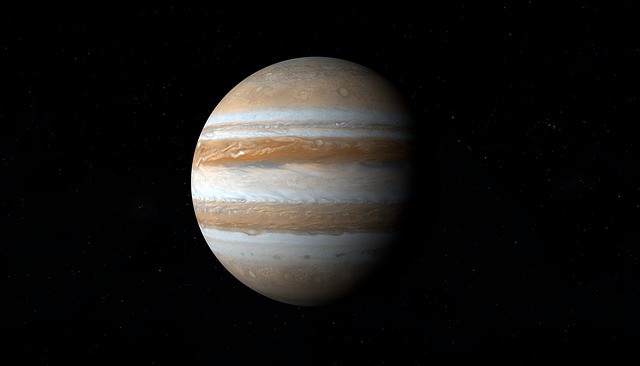
Planet Jupiter is famous for its striking cloud bands and violent atmospheric activity. Thick layers of clouds stretch around the planet in alternating light and dark bands caused by powerful jet streams moving at hundreds of kilometres per hour.
The most iconic feature is the Great Red Spot, a colossal storm that has raged for at least 350 years. Large enough to engulf Earth, this storm represents the immense energy trapped within Jupiter’s atmosphere. Smaller storms continuously form, merge, and dissipate, creating an ever-changing planetary canvas.
Jupiter’s Atmosphere: Depth, Pressure, and Power
The atmosphere of Planet Jupiter is composed primarily of hydrogen and helium, similar to the material that formed the Sun. Beneath the visible clouds, pressure increases dramatically, compressing gases into exotic states of matter.
Deeper layers contain metallic hydrogen, a rare form that conducts electricity and helps generate Jupiter’s powerful magnetic field. Temperatures rise rapidly with depth, reaching thousands of degrees. Unlike rocky planets, Planet Jupiter has no solid surface, only increasingly dense layers of gas and liquid.
Inside Planet Jupiter: Core and Magnetic Field
The interior of Planet Jupiter remains one of astronomy’s great mysteries. Scientists believe the planet contains a dense core made of heavy elements, surrounded by layers of liquid metallic hydrogen and molecular hydrogen.
Jupiter’s magnetic field is the strongest of any planet in the Solar System. It creates massive radiation belts that trap charged particles and extend millions of kilometres into space. This magnetic environment affects spacecraft, moons, and even auroras that glow brighter than those on Earth.
Jupiter’s Moons: A Mini Solar System
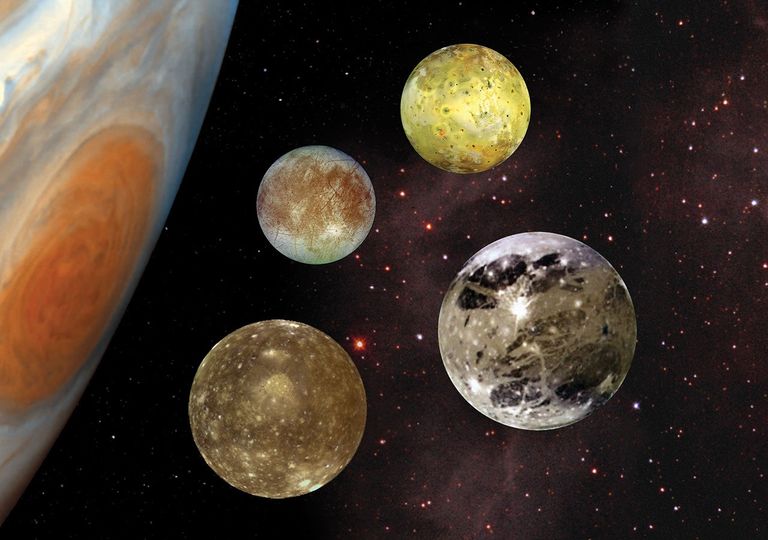
Planet Jupiter hosts the largest moon system in the Solar System. Its four largest moons, Io, Europa, Ganymede, and Callisto, are known as the Galilean moons, and each is a world of extremes.
Io is the most volcanically active body known, driven by tidal heating. Europa hides a vast subsurface ocean beneath its icy crust, making it a prime candidate in the search for extraterrestrial life. Ganymede is the largest moon in the Solar System and even has its own magnetic field. Callisto preserves an ancient, heavily cratered surface that records early Solar System history.
Exploring Planet Jupiter: Missions and Discoveries
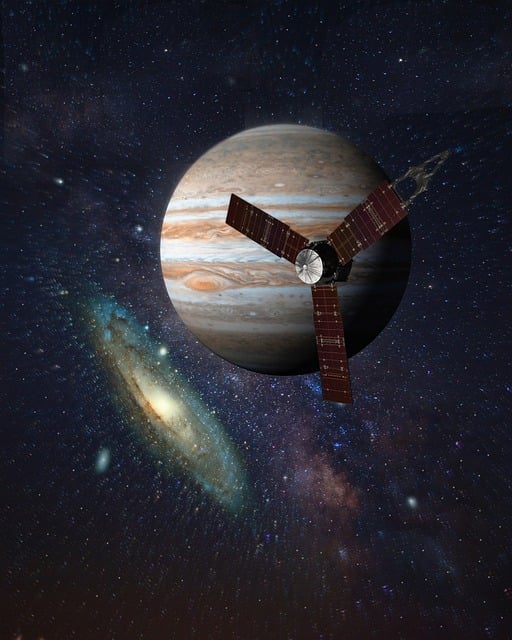
Exploration of Planet Jupiter began with early flybys, but missions like Galileo revolutionised our understanding by studying the planet and its moons in detail. The Juno spacecraft is currently providing unprecedented insights into Jupiter’s gravity field, magnetic structure, and deep atmospheric layers.
Juno’s observations revealed that Jupiter’s core may be diffuse rather than compact, reshaping theories of gas giant formation. Future missions aim to focus on Jupiter’s moons, particularly Europa, where hidden oceans may hold the ingredients for life.
Why Planet Jupiter Matters to Astronomy
Planet Jupiter serves as a natural laboratory for studying gas giants throughout the universe. Many exoplanets discovered around other stars resemble Jupiter in size and composition. Understanding Jupiter helps scientists interpret these distant worlds.
Jupiter also influences the habitability of inner planets by shaping orbital dynamics and impact rates. Its presence may have been essential to Earth’s long-term stability and the emergence of life.
Jupiter, Power, and Planetary Wonder
Planet Jupiter stands as a reminder of the raw power and complexity of planetary systems. Its storms, moons, magnetic forces, and sheer scale challenge our understanding of how planets form and evolve.
As exploration continues, Planet Jupiter will remain central to astronomy, offering clues not only about our Solar System’s past, but about planetary systems across the galaxy.