
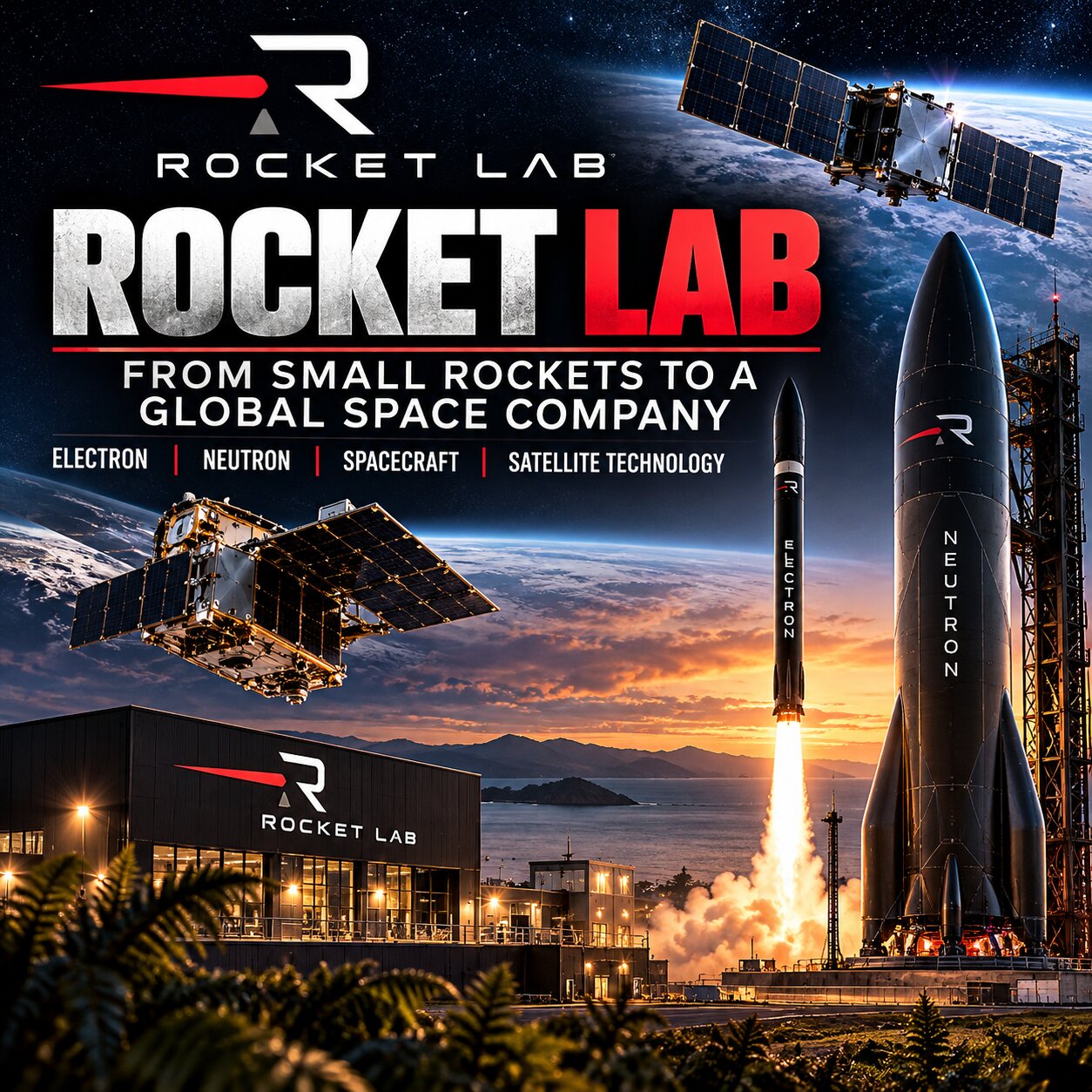

SpaceX and Blue Origin might attract much of the attention surrounding commercial spaceflight, but another company has steadily developed into an important participant in the modern space economy.
Rocket Lab began by concentrating on dedicated launches for small satellites. Today, its ambitions extend considerably further. The company describes itself as an end-to-end space company, with activities encompassing launch services, spacecraft, satellite components, software and on-orbit operations. Rocket Lab
At the centre of its story is Electron, the small orbital rocket that established Rocket Lab in the commercial launch industry. The company is now developing the much larger Neutron while simultaneously expanding its spacecraft and component businesses.
For the space economy, Rocket Lab provides an interesting example of how a launch provider can evolve into something much larger.
Where Did Rocket Lab Begin?
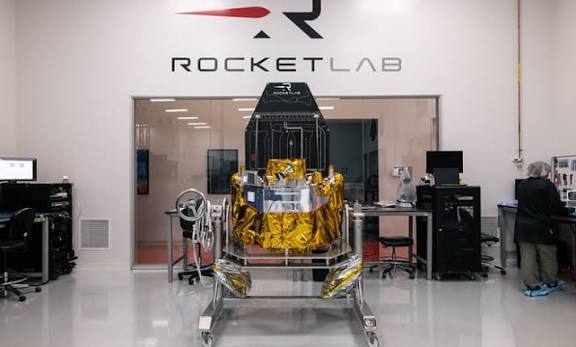
Rocket Lab was founded in 2006 by Peter Beck in New Zealand. While its corporate headquarters are now in Long Beach, California, New Zealand remains fundamental to its launch operations.
Its breakthrough orbital vehicle was Electron, developed specifically around the growing small-satellite market.
Rather than competing directly with enormous rockets carrying very large payloads, Electron provides dedicated access to orbit for smaller spacecraft. Customers can therefore purchase missions designed around their particular payload and orbital requirements instead of always relying on available capacity aboard a much larger rocket.
Rocket Lab operates three dedicated launch pads across two launch sites: Launch Complex 1 in New Zealand and Launch Complex 2 in Virginia in the United States. Rocket Lab Corporation
Meet the Electron Rocket
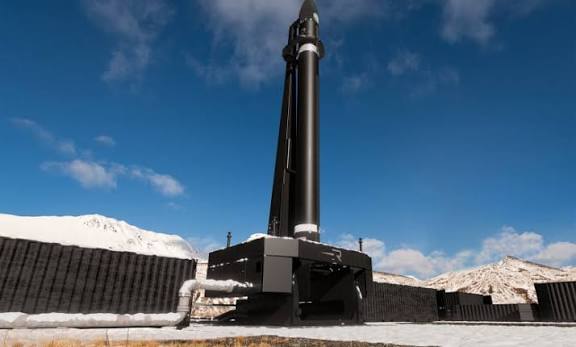
Electron is an 18-metre, two-stage orbital launch vehicle with an additional Kick Stage available for precise payload deployment. It uses carbon-composite structures and liquid oxygen and kerosene propellants, with a listed payload capacity of up to 300 kg to low Earth orbit. Rocket Lab
One of its most interesting technologies is the Rutherford engine.
Rocket Lab describes Rutherford as the world’s first 3D-printed, electric-pump-fed rocket engine. Nine Rutherford engines power Electron’s first stage, while a vacuum-optimised version powers the second. Rocket Lab
The optional Kick Stage adds flexibility after the main rocket stages have completed their work. It can perform multiple trajectory changes and deploy spacecraft into different orbital positions, allowing Rocket Lab to provide more specialised delivery services for small satellites. Rocket Lab
Electron has consequently become much more than an experimental small rocket.
On 26 September 2026, Rocket Lab completed its 97th Electron mission, carrying the 13th StriX radar-imaging satellite launched by Rocket Lab for Japanese Earth-observation company Synspective. It was Electron’s 18th mission of 2026. Rocket Lab Corporation
Why Dedicated Small-Satellite Launches Matter
The satellite industry has changed dramatically.
Modern spacecraft don’t necessarily need to resemble the enormous satellites historically associated with telecommunications and government programmes. Smaller spacecraft can perform Earth observation, scientific research, communications and technology demonstrations.
Constellations can involve dozens or even hundreds of satellites working together.
That creates demand for reliable ways of reaching specific orbits.
Rideshare missions aboard larger rockets can provide an economical route into space, but customers don’t always control the launch date or precise destination. A smaller dedicated vehicle gives satellite operators another option.
Rocket Lab has built much of Electron’s commercial proposition around that flexibility.
Its 2026 relationship with Synspective demonstrates the model particularly well. By September, Electron had deployed all 13 StriX spacecraft launched under their partnership successfully, with another 14 launches scheduled to continue building the constellation through the end of the decade. Rocket Lab Corporation
Rocket Lab Builds Spacecraft Too
Looking at Rocket Lab purely as a rocket company now misses a significant part of its business.
The company designs and manufactures spacecraft and supplies components including reaction wheels, solar cells, solar panels and arrays, radios, avionics, separation systems, propulsion equipment and flight software.
Rocket Lab says its satellite components have flown on more than 1,700 spacecraft, while its spacecraft production facilities are located in Long Beach. Rocket Lab
Its spacecraft technology has been associated with missions extending beyond Earth orbit too. Rocket Lab hardware has been selected for missions involving the Moon and Mars, as well as a planned private mission to Venus. Rocket Lab Corporation
This expansion is strategically important.
Instead of earning revenue only when one of its rockets launches, Rocket Lab can participate in numerous stages of a space mission.
Neutron Is Rocket Lab’s Next Big Step
Electron established Rocket Lab in small launch, but Neutron represents a much larger ambition.
Neutron is a reusable medium-lift rocket currently under development. Rocket Lab lists the vehicle at 43 metres tall with a seven-metre diameter and a planned capability of carrying up to 13,000 kg into low Earth orbit. It will use liquid oxygen and methane and be powered by Rocket Lab’s reusable Archimedes engines. Rocket Lab
That places Neutron in an entirely different category from Electron.
Rocket Lab intends the vehicle to support satellite constellations, national-security missions and exploration beyond Earth orbit. The company has already been selling future Neutron launches: in May 2026, it announced a contract with an undisclosed customer covering five Neutron and three Electron missions. Rocket Lab
Successfully bringing Neutron into regular operation would therefore expand the range of missions Rocket Lab can pursue considerably.
More Than Rockets
Perhaps the most interesting aspect of Rocket Lab is the increasingly integrated nature of its business.
The company can manufacture satellite components. It can build spacecraft. It operates rockets capable of delivering spacecraft into orbit. It can provide mission software and support spacecraft once they are there.
That model means Rocket Lab increasingly participates across multiple sections of the space industry’s supply chain rather than occupying only the launch segment. Rocket Lab
Its financial scale has also been growing. For the second quarter of 2026, Rocket Lab reported record quarterly revenue of $234 million and a record backlog of $2.36 billion. Rocket Lab Corporation
Those numbers don’t guarantee how the company’s future projects will perform, but they illustrate how far the business has developed beyond its early small-launch identity.
Rocket Lab and the Expanding Space Economy
Commercial spaceflight isn’t developing around a single company or rocket.
Different businesses are pursuing different sections of an increasingly complex economy involving launch vehicles, satellites, communications, private space stations, Earth observation, defence, lunar exploration and eventually missions farther into the Solar System.
Rocket Lab occupies an interesting position within that landscape.
Electron has given the company an established operational launch system, while its spacecraft and component divisions allow it to participate in missions even when another company’s rocket provides the ride. Neutron is intended to open access to substantially larger payloads.



Leave a Reply