
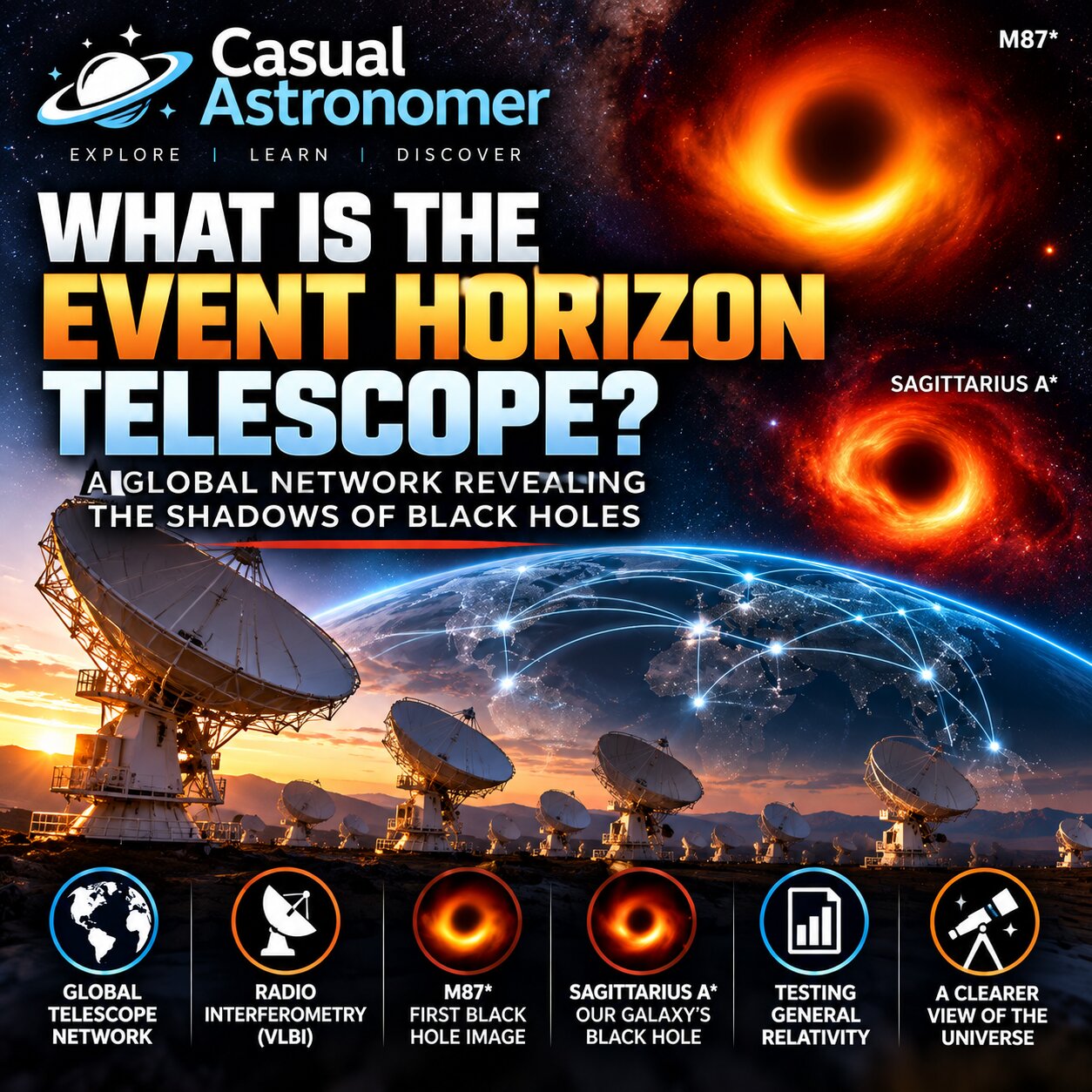

Black holes are among the most extreme objects in the Universe, yet astronomers have achieved something that once seemed almost impossible: obtaining images of the regions immediately surrounding them. The instrument responsible is the Event Horizon Telescope, or EHT.
Despite its name, the Event Horizon Telescope is not a single enormous telescope. It is an international network of radio observatories distributed across Earth. By precisely combining observations from these facilities, astronomers can create the equivalent resolving power of a telescope almost as large as our planet.
The result has transformed black hole astronomy.
What Is the Event Horizon Telescope?
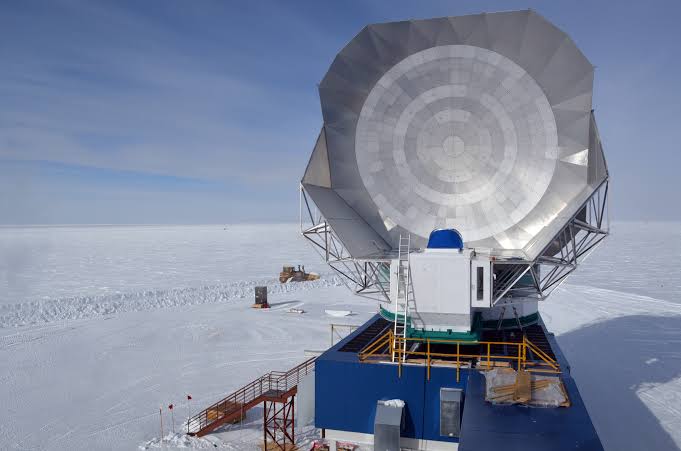
The Event Horizon Telescope is a global network of radio telescopes designed to observe extremely compact astronomical objects at exceptionally high angular resolution.
Its primary targets have included supermassive black holes located at the centres of galaxies.
Individual radio telescopes are limited by the diameter of their collecting dishes. Building a conventional telescope thousands of kilometres wide would obviously be impossible. Instead, the EHT uses a technique known as very-long-baseline interferometry, commonly abbreviated as VLBI.
Observatories separated by thousands of kilometres observe the same astronomical target simultaneously. Their data can later be combined, effectively allowing the network to achieve angular resolution corresponding to the enormous distances separating the telescopes.
This gives the Event Horizon Telescope extraordinary resolving power.
How Does the Event Horizon Telescope Work?
EHT observatories detect radio waves at millimetre wavelengths. These wavelengths are particularly useful because they can penetrate much of the gas and dust surrounding galactic centres while providing the resolution needed to investigate regions around supermassive black holes.
Synchronisation is critical.
Each participating observatory uses extremely precise atomic clocks to timestamp its observations. The enormous quantities of recorded data are then physically transported to specialised processing facilities, where powerful computers correlate the observations.
Interferometry uses differences in the arrival of radio signals at separate telescopes to reconstruct information about the source.
However, the Event Horizon Telescope cannot simply take a photograph in the way a conventional camera does. Researchers use sophisticated computational techniques to reconstruct images from the interferometric measurements.
Can We Actually See a Black Hole?
Strictly speaking, the famous EHT images do not show the black hole itself.
A black hole has an event horizon, a boundary beyond which light cannot escape. Since no light travels outward from within this region, the black hole cannot be directly photographed.
What astronomers can detect is radiation emitted by extremely hot material surrounding it.
Strong gravity dramatically bends the paths of photons near the black hole. This creates a bright ring-like structure surrounding a dark central region often described as the black hole’s shadow.
The size and shape of that shadow provide scientists with valuable information about the black hole and the gravitational environment surrounding it.
The First Image of M87*
In April 2019, the Event Horizon Telescope collaboration released the first image of a black hole’s shadow.
The target was M87*, the supermassive black hole located at the centre of the giant elliptical galaxy Messier 87, roughly 55 million light-years from Earth.
The image revealed a bright ring surrounding a dark central region.
M87* has a mass billions of times greater than that of our Sun. Its enormous physical size made its event-horizon-scale structure suitable for observation despite its extraordinary distance from Earth.
The image became one of the most recognisable astronomical achievements of the 21st century.
Imaging Sagittarius A*
The EHT collaboration later turned its attention closer to home.
At the centre of the Milky Way lies Sagittarius A*, or Sgr A*, a supermassive black hole approximately 27,000 light-years from Earth.
In 2022, the collaboration released the first image of Sagittarius A*.
Although much closer than M87*, Sgr A* presented a different observational challenge. It is considerably less massive, meaning material in its immediate surroundings changes on much shorter timescales.
Imagine trying to photograph a subject that changes appearance while your camera is still gathering the information needed to construct the image. Researchers needed specialised methods to account for this variability.
Why Is the Event Horizon Telescope Important?
The Event Horizon Telescope gives astronomers an opportunity to investigate gravity under some of the most extreme conditions found in nature.
Measurements of black hole shadows can be compared with predictions derived from Einstein’s general theory of relativity. Researchers can also study magnetic fields, accretion flows and the mechanisms associated with powerful relativistic jets produced around some supermassive black holes.
Future improvements could produce increasingly detailed observations.
Adding more observatories to the network improves coverage, while technological developments may allow observations at additional frequencies and eventually create sequences showing how material near black holes changes over time.
Turning Earth into a Virtual Telescope
The Event Horizon Telescope demonstrates what becomes possible when observatories across the planet operate as one scientific instrument.
No single telescope could have produced these observations alone. Instead, precisely synchronised radio observatories, atomic clocks, enormous datasets, advanced computing and international scientific cooperation effectively transformed Earth itself into part of the telescope.
The result allows humanity to investigate environments immediately surrounding objects from which light itself cannot escape.
The Event Horizon Telescope has already given us our first visual evidence of black hole shadows. As the network and its technology continue to improve, it may reveal even more about gravity, matter and some of the most extreme environments in the Universe.

Leave a Reply