Astronomers have recently observed what may be the first-ever “super-kilonova”, a powerful cosmic explosion unlike anything seen before. The discovery has left scientists rethinking how some of the universe’s most extreme events work.
But before we can understand what makes a super-kilonova special, there’s a more basic question to answer:
What on Earth is a kilonova?
A Never-Before-Seen Double Explosion
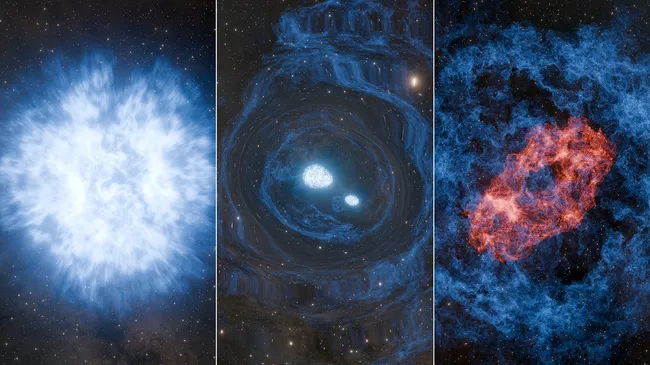
Astronomers believe they may have observed a completely new kind of cosmic event: a double explosion in which a massive dying star appears to have split apart and then crashed back together, unleashing two distinct but connected blasts.
The event, designated AT2025ulz, first drew attention in August 2025 when gravitational-wave detectors picked up subtle ripples in space-time, suggesting the merger of two extremely dense objects. Shortly afterwards, telescopes detected a faint red glow at the same location, consistent with the aftermath of a neutron-star collision.
What made AT2025ulz extraordinary was what happened next. Instead of steadily fading, as kilonovas usually do, the object began to brighten again. Follow-up observations showed the light shifting toward bluer wavelengths and revealed traces of hydrogen, a chemical signature normally associated with supernova explosions, not kilonovas.
This unexpected behaviour suggests that the event may combine features of both phenomena. Scientists suspect a massive star may have partially collapsed or split, triggering a kilonova-like merger before igniting a second, supernova-style explosion. If confirmed, AT2025ulz could represent the first observed example of a long-theorised “super-kilonova”, capable of forging some of the universe’s heaviest elements while also producing powerful gravitational waves.
Researchers stress that the interpretation is still under investigation, but even so, the discovery is already challenging existing models of how the most extreme stellar deaths unfold.
News Source: Live Science
What Is a Kilonova?
A kilonova is a rare and extremely energetic explosion that happens when two neutron stars collide, or when a neutron star merges with a black hole.
Neutron stars are the ultra-dense remains of massive stars that have already exploded as supernovae. When two of these stellar corpses spiral into each other, the collision releases an enormous burst of energy.
This explosion is called a kilonova because it is roughly 1,000 times brighter than a typical nova, but usually less powerful than a full supernova.
Why Kilonovas Are So Important
Kilonovas are not just violent explosions. They are believed to be cosmic factories for heavy elements.
Many of the elements we find on Earth, including:
- gold
- platinum
- uranium
are thought to be created during kilonova explosions. The extreme conditions allow atomic nuclei to rapidly fuse, producing elements that cannot easily form inside normal stars.
In other words, some of the precious metals on Earth may have been forged in ancient kilonovas billions of years ago.
How Kilonovas Were Discovered
For decades, kilonovas were only theoretical. Scientists suspected they existed but had no direct proof.
That changed in 2017, when astronomers detected both:
- gravitational waves from a neutron star merger, and
- light from the resulting explosion
This confirmed that kilonovas were real and marked the beginning of a new era in astronomy, where scientists could observe the universe using both light and gravitational waves.
So What Makes This a “Super-Kilonova”?
The recently observed event appears to be far brighter and longer-lasting than any known kilonova.
Early data suggests:
- the explosion released more energy than expected
- it may involve a more complex system, possibly two massive stars in a tight orbit
- it does not fit neatly into existing models of neutron star mergers
Because of this, scientists are calling it a super-kilonova, although the term is informal for now.
If confirmed, it could represent:
- a new class of cosmic explosion, or
- a missing link between kilonovas and supernovae
Why This Discovery Matters
If super-kilonovas are real, they could:
- change how we understand the death of massive stars
- explain the origin of even heavier elements
- refine models of gravitational wave sources
- reveal previously unknown stages of stellar evolution
In short, this is not just a new explosion. It may be a new chapter in cosmic physics.
A New Kind of Cosmic Firework
Kilonovas already represent some of the most extreme events in the universe. The possible discovery of a super-kilonova suggests that nature may have even more powerful and complex explosions waiting to be understood.
As astronomers continue to analyse the data, this event could reshape what we know about neutron stars, heavy elements, and the violent processes that shape the cosmos.
For now, one thing is certain: the universe has once again surprised us.